Architect Specifications
Free specification language for architects, specifiers, engineers and facility designers.
The American Floor Safety Alliance (AFSA) provides this model language to help design professionals establish objective, measurable pedestrian slip-resistance requirements for flooring and walkway surfaces.
The language below may be incorporated or adapted into architectural master specifications and individual project specifications.
Which test method should I specify?
AFSA recommends AFSA FS101 as the preferred test method for pedestrian slip resistance.
FS101 was developed specifically for pedestrian floor-safety assessment and provides detailed requirements for test conditions, slider selection, instrument verification, test procedure, reporting and interpretation of Pendulum Test Values (PTV).
Where a project, jurisdiction or firm policy requires an ASTM test method, ASTM E303 may be specified as an alternative.
ASTM E303 utilizes the same fundamental pendulum testing instrument, but it is a more general test method and does not provide all of the pedestrian-specific guidance contained in AFSA FS101.
Recommended: Specify AFSA FS101 whenever permitted. Where ASTM E303 is required, the project specification should also clearly state the required PTV, wet or dry test condition, appropriate slider, and other pedestrian-safety requirements necessary to interpret the test result.
Level pedestrian surfaces expected to become wet:
Minimum Wet PTV ≥ 36
AFSA FS101
Does the Pendulum Tester Measure Dynamic Coefficient of Friction?
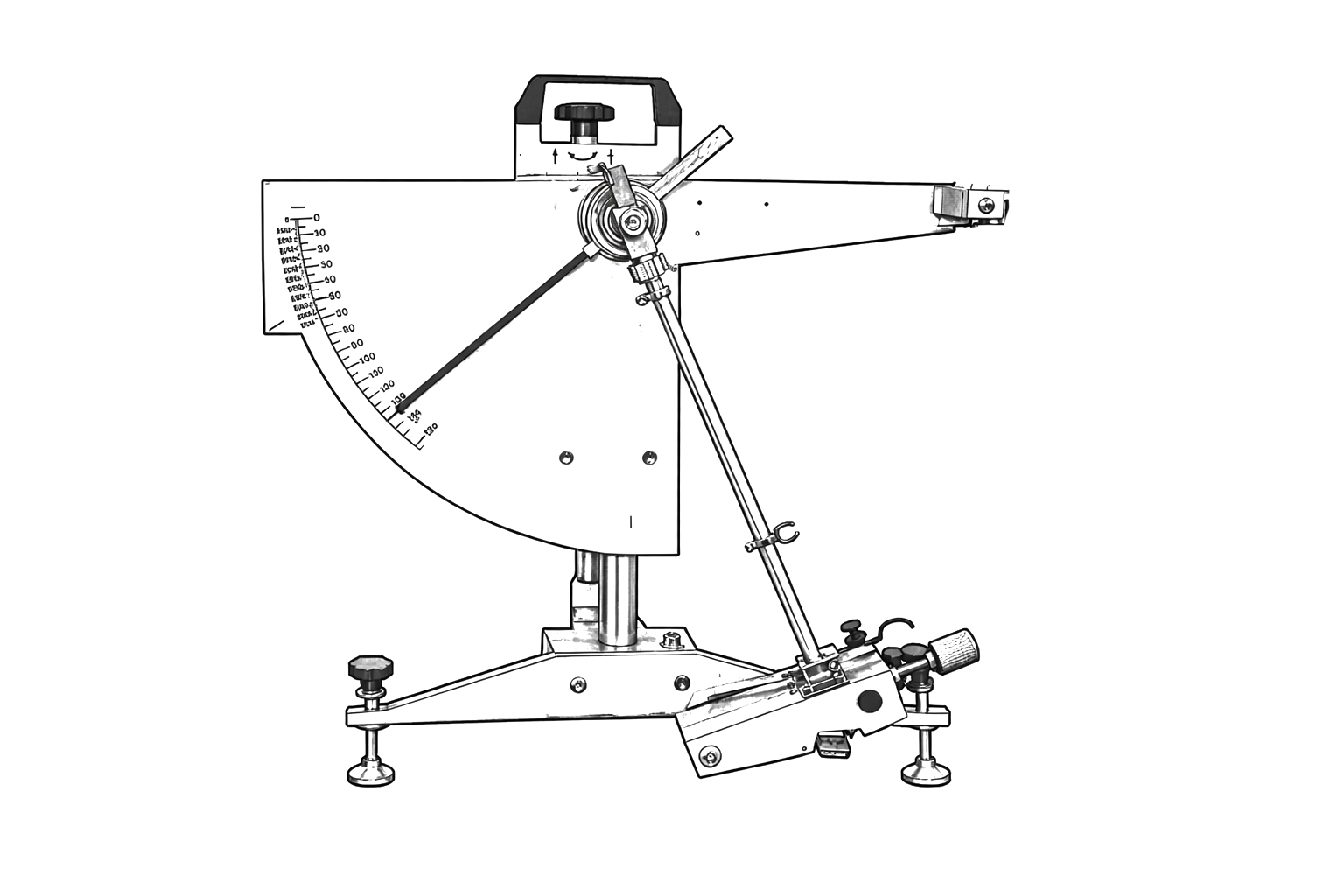
Yes. The pendulum tester assesses dynamic friction as a rubber slider moves across the surface. It measures the energy lost through friction during that sliding contact. For pedestrian slip-resistance assessments, results are traditionally reported as Pendulum Test Values (PTV).
Reporting results in PTV helps keep the measurement tied to the pendulum test and its applicable safety criteria. Different friction test methods can produce different numerical results on the same surface because they use different slider materials, contact conditions, speeds, and measurement procedures.
Safety criteria are therefore specific to the test method and are not interchangeable. A DCOF requirement established for another instrument should not be applied to a pendulum result. Specifiers should identify the test method, slider type, test conditions, and required minimum PTV together.
Recommended Specification Language
Pedestrian Slip Resistance – Performance Requirement
Flooring and pedestrian walkway surfaces shall provide slip resistance appropriate for their intended use and reasonably foreseeable service conditions. Where surfaces may become wet in service, slip resistance shall be evaluated under wet conditions.
Slip resistance shall be measured using a pendulum friction tester in accordance with AFSA FS101, Standard Method for Slip Resistance Testing, current edition. Where ASTM terminology is required by the project documents, the pendulum apparatus shall conform to the applicable requirements of ASTM E303, with pedestrian testing, verification, slider selection, test conditions and interpretation performed in accordance with AFSA FS101.
A manufacturer’s characterization of flooring as “slip resistant,” “non-slip,” “high traction,” or similar terminology shall not constitute evidence of compliance without appropriate pendulum test data.
Recommended Minimum Pendulum Test Values
For a level pedestrian surface expected to become wet, AFSA recommends specifying a minimum wet Pendulum Test Value (PTV) of 36 using the appropriate slider specified by AFSA FS101.
| Wet PTV | Slip Potential |
|---|---|
| 0–24 | High |
| 25–35 | Moderate |
| 36–54 | Low |
| 55+ | Very Low |
PTV 36 should generally be treated as a minimum rather than a design target where greater slip resistance is reasonably achievable.
Higher requirements may be appropriate for ramps, stairs, pool environments, barefoot areas, surfaces exposed to contaminants, facilities serving vulnerable populations, and other higher-risk applications. The project designer should select the requirement appropriate to the anticipated pedestrian population and conditions of use.
The chart below provides the American Floor Safety Alliance’s recommended minimum wet Pendulum Test Values (PTV) for specific locations and uses. These guidelines draw on decades of slip-resistance research in Australia, the United Kingdom, and around the world, helping project designers select requirements appropriate to the anticipated pedestrian population and conditions of use.
Situation-Specific AFSA FS101 Recommended Minimum Wet PTV
| Building or walkway type | Line no. | Location or function of area | Minimum wet PTV | |
|---|---|---|---|---|
| Hard rubber slider | Soft rubber slider | |||
| External sidewalks and ramps | 1 | External ramps with slopes steeper than 1 in 14 (4.1 degrees) | 55 | 45 |
| 2 | External ramps, slopes less than 1 in 14 | 45 | 40 | |
| 3 | Level surfaces: external parking lots, external walkways, pedestrian crossings (including painted crosswalks and speedbumps), balconies, driveways, courtyards, decks | 45 | 40 | |
| 4 | Parking lots, covered | 36 | 36 | |
| Hospitals and assisted-living facilities | 5 | Bathrooms and bathtubs/showers in hospitals and assisted-living facilities | 36 | 36 |
| 6 | Wards and corridors in hospital and aged care facilities | 25 | 20 | |
| Hotels, office buildings, public buildings, schools, kitchens; entries and access areas | 7 | Dry area (such as an office) | 12 | 12 |
| 8 | Hotel bathrooms, tubs and showers | 36 | 36 | |
| 9 | Kitchens | 45 | 40 | |
| 10 | Restroom facilities in offices, bars and shopping centers | 36 | 36 | |
| 11 | Serving areas – bars, kitchens, buffet lines | 36 | 36 | |
| 12 | Freezers in kitchens | 45 | 40 | |
| Loading docks | 13 | Indoor loading docks | 55 | 45 |
| Sports/concert stadiums | 14 | All areas besides stairs | 36 | 36 |
| Supermarkets and shopping centers | 15 | Dry areas in shopping centers (canned goods aisles, for instance) | 12 | 12 |
| 16 | Fast food outlets, buffets, food courts and fast food dining areas in shopping centers | 36 | 36 | |
| 17 | Fresh fruit and vegetable areas in supermarkets | 36 | 36 | |
| 18 | Shop entry areas with external entrances | 36 | 36 | |
| Swimming pools and sports facilities | 19 | Locker rooms | 36 | 36 |
| 20 | Showers | 36 | 36 | |
| 21 | Swimming pool decks | 45 | 40 | |
| 22 | Swimming pool ramps and stairs leading to water | 55 | 45 | |
| Stairs | 23 | Dry stairs and landings | 36 | 36 |
| 24 | Wet stairs and landings | 45 | 40 | |
Why ANSI A326.3 and Pendulum Criteria Are Not Interchangeable
Although ANSI A326.3 and pendulum testing both measure dynamic friction, they use different procedures and reporting scales. Their numerical results and acceptance criteria are not interchangeable.
The introduction to ANSI A326.3-2021, published in February 2022, states that its measurement:
“does not predict the likelihood a person will or will not slip on a hard surface flooring material.”
ANSI A326.3 provides DCOF measurements and product-use classifications. Meeting one of its criteria must not be presented as proof that a floor is safe or that a person will not slip. The standard also acknowledges that three-dimensional patterns or profiled surfaces can produce misleading DCOF measurements because of test-device constraints. “Profiled surfaces” can often include epoxy and similar-type floors that have grit applied to the top coat.
Do not apply ANSI A326.3 DCOF requirements to Pendulum Test Values (PTV), and do not apply pendulum PTV requirements to ANSI A326.3 results. Each acceptance criterion must remain tied to the method and conditions for which it was established.
HSE Warns Against Sled Tests on Wet or Contaminated Floors
The United Kingdom’s Health and Safety Executive (HSE) explains that sled tests can accurately measure floor friction on completely clean, dry floors, but explicitly warns:
“It is STRONGLY RECOMMENDED that such tests are NOT used to assess the slipperiness of wet or contaminated floors.”
HSE explains that sled tests can produce misleading information under those conditions because they do not recreate the pedestrian gait conditions responsible for most slip injuries. Examples of drag-sled instruments include the BOT-3000E and TRACSCAN 2.0. HSE’s warning addresses the test category rather than naming individual models.
HSE reports that most workplace slips occur on contaminated surfaces. Rainwater, grease, spilled drinks, and soap solutions can change the traction available to pedestrians. Testing a floor only when clean and dry does not establish its slip resistance when wet or contaminated. An assessment must address foreseeable conditions of use.
The United Kingdom Slip Resistance Group, or UKSRG, is a leading resource in this field of crucial safety, and it makes a similar recommendation about sled tests.
Withdrawn ASTM Standards and Misleading Slip-Resistance Results
ASTM C1028, F489, F1677, F1678, and F1679 have all been withdrawn. C1028 was withdrawn in 2014; F489 and F1678 in 2005; and F1677 and F1679 in 2006. Their continued appearance in specifications or expert reports does not establish that their measurements reliably assess pedestrian slip potential.
The problem goes beyond outdated references: a test can produce an impressive number without accurately identifying a slippery floor. Static coefficient of friction (SCOF) measures resistance to initiating movement; dynamic friction concerns sliding contact. A static reading must not be substituted for the dynamic friction assessment and method-specific acceptance criteria required by a specification.
Stiction Can Make a Slippery Surface Look Safer
ASTM C1028 has a documented problem with stiction. On smooth or polished wet surfaces, surface tension can cause the stationary sensor to stick to the flooring. Breaking that adhesion requires additional force, producing an artificially high reading that can overstate the traction available to a pedestrian.
The Tile Council of North America (TCNA) acknowledges this limitation in its explanation of the move away from ASTM C1028. A sensor sticking to a wet floor is not proof that a walking person will have adequate traction. Treating that reading as assurance of safety can conceal the hazard the test was supposed to identify.
After years of promoting ASTM C1028, the Tile Council of North America—a tile industry trade association, not an independent safety organization—published ANSI A326.3. Yet the standard’s own introduction states that its measurement “does not predict the likelihood a person will or will not slip on a hard surface flooring material.” Industry compliance must not be mistaken for proof of pedestrian safety.
Published Research Identifies the Failures
Bowman, Strautins, Westgate and Quick (2002), published in ASTM STP 1424, found that the manually pulled drag sled used in ASTM C1028 could not satisfactorily distinguish between the wet slip resistance of ceramic tiles. Under the conditions examined, pendulum testing with the softer TRL rubber also provided more reliable results than the English XL variable-incidence tribometer associated with ASTM F1679.
In his February 2024 statement on SCOF testing and ASTM D2047, occupational hygienist and materials scientist Carl Strautins states:
“There is no scientific association between static coefficient of friction and the probability of a slip occurring.”
Strautins explains that SCOF testing lacks adequate similarity to real-world slipping conditions, particularly the lubricating film involved in wet slips. He calls for its withdrawal unless proponents can supply rigorous scientific validation.
A further study by Siegmund and colleagues, published online in 2020 in Ergonomics, examined the English XL and Slip-Test Mark IIIB. It found that 51–82% of the total measurement variance was attributable to the operator, individual instrument, surface sample, and interaction between operator and instrument. Repeated measurements by one operator using one instrument therefore fail to capture most of the measurement uncertainty. A tightly grouped set of readings can appear precise while concealing substantial variation between users and instruments.
ASTM D2047 Does Not Establish Wet-Floor Safety
ASTM D2047 remains active, but it is a dry laboratory SCOF test for polish-coated flooring using the James Machine. Its scope excludes wet surfaces, and its compliance criterion does not address contaminated flooring. A passing D2047 result must not be used to declare a floor safe when wet or contaminated.
Its acceptance criterion applies only to polish-coated surfaces tested with the specified machine and procedure. ASTM states that applying this criterion to other instruments, methods, or surfaces is improper.
Specify Testing That Addresses the Actual Hazard
Both HSE and the United Kingdom Slip Resistance Group (UKSRG) recommend pendulum testing for assessing floor slip resistance. HSE identifies it as its standard method for dry and contaminated conditions. ASTM E303 and FS101 support pendulum testing in both the laboratory and the field.
Testing must be performed and interpreted by a suitably trained, competent operator. Profiled flooring requires additional care and may require testing in several directions.
Specifiers should replace withdrawn-method requirements with scientifically supported testing and method-specific acceptance criteria. For pendulum specifications, identify the applicable test standard, rubber slider, wet or dry conditions, and required minimum PTV. Select the requirement appropriate to the location, pedestrian population, and anticipated conditions of use.
An obsolete standard number, an inapplicable friction threshold, or a clean-and-dry result cannot establish that foreseeable wet-floor hazards have been adequately evaluated.
Sources:
- ANSI A326.3 and supporting information
- HSE guidance on sled tests
- HSE: Assessing the slip resistance of flooring
- TCNA explanation of C1028 and stiction
- Carl Strautins’ statement and supporting research
- Siegmund et al.: Quantifying the uncertainty in tribometer measurements on walkway surfaces
- ASTM D2047 scope and limitations
- UKSRG pendulum recommendation
Provide flooring having a wet Pendulum Test Value (PTV) of not less than 36 when tested in accordance with AFSA FS101, current edition, using the appropriate standardized slider for the anticipated pedestrian use. Test surfaces under conditions representative of reasonably foreseeable service conditions. Where slopes, barefoot use, unusual contaminants, or other elevated slip-risk conditions are present, provide the higher slip-resistance performance required by AFSA FS101 for the applicable condition.
Pendulum Tester in Action
Healthcare and Other High-Consequence Environments
Hospitals, senior-living facilities, rehabilitation facilities, assisted-living facilities and other environments serving populations particularly vulnerable to fall injuries deserve special consideration. The design professional should evaluate whether merely meeting a minimum requirement provides an appropriate margin of safety for the intended population and location.
Particular attention should be given to:
- Building entrances
- Emergency entrances
- Patient bathrooms
- Public restrooms
- Showers and bathing facilities
- Rehabilitation areas
- Food-service areas
- Kitchens
- Ramps
- Exterior walkways
- Areas exposed to tracked-in rain or snow
- Transitions between flooring materials
- Locations where contamination can reasonably be anticipated
Shod and Barefoot Areas
AFSA FS101 provides for two standardized rubber sliders selected according to the intended pedestrian environment.
Slider 96 (“Four S”) is used for evaluation relevant to standard shod pedestrian traffic.
Slider 55 (“TRL”) is used for barefoot or soft-soled conditions.
Areas such as swimming pools, spas, showers and changing facilities may require evaluation appropriate to barefoot use.
Mixed-use environments may require evaluation using both sliders.
Require Testing Under Foreseeable Conditions
A dry slip-resistance result does not establish the safety of a floor when wet. Where water or another contaminant can reasonably be anticipated during use, the specification should require testing under the relevant condition.
Examples include rain at building entrances, water around pools and showers, food or grease in food-service environments, and contaminants associated with industrial or specialized facilities.
Product Submittals
Where pedestrian slip resistance is a project requirement, require the flooring manufacturer or supplier to submit test documentation identifying:
- Exact flooring product and surface finish tested.
- Test standard used.
- Pendulum Test Value.
- Wet or dry test condition.
- Slider used.
- Testing laboratory or testing professional.
- Test date.
- Instrument identification.
- Required instrument verification information.
- Any treatment, coating, sealer or maintenance product applied to the specimen.
Results produced by materially different test instruments or methodologies should not be assumed to be interchangeable.
Field Verification After Installation
For projects where pedestrian safety is important, AFSA recommends considering field verification of the finished, installed walking surface before acceptance.
Suggested language:
After completion of flooring installation and final cleaning, test representative areas of the installed walking surface in accordance with AFSA FS101. Demonstrate compliance with the specified Pendulum Test Value under the specified test condition before final acceptance.
This is important because installation, polishing, sealing, coatings, cleaning products and construction contamination can affect the slip resistance of the finished surface.
Testing a manufacturer’s sample before construction does not necessarily establish the performance of the floor actually delivered to the building owner.
Why AFSA FS101?
ASTM E303 provides a recognized method utilizing the pendulum friction tester. AFSA FS101 applies pendulum testing specifically to pedestrian slip-resistance assessment and incorporates additional requirements relevant to floor-safety evaluation.
AFSA FS101 defines Pendulum Test Value (PTV), wet testing, standardized sliders for different pedestrian conditions, instrument requirements, slider conditioning, verification procedures and interpretation of results.
The pendulum approach also allows American architects and safety professionals to draw upon extensive international experience with pedestrian pendulum testing.
For Specification Writers
AFSA encourages architectural firms to incorporate objective pedestrian slip-resistance requirements into their master specifications, rather than addressing floor safety individually after products have already been selected.
If your firm’s current master specification references another slip-resistance test, AFSA does not recommend simply replacing the test name without considering:
- The required safety performance
- Wet versus dry conditions
- Anticipated pedestrian population
- Appropriate slider
- Slopes
- Contaminants
- Field verification
- Conditions unique to the project
The objective is not simply to specify a test.
Copy-and-Paste Short Form
For firms needing a concise master-specification provision:
Provide pedestrian flooring having a wet Pendulum Test Value (PTV) of not less than 36 when tested in accordance with AFSA FS101, Standard Method for Slip Resistance Testing, current edition, using the appropriate standardized slider for the anticipated pedestrian use. Where flooring is sloped, intended for barefoot use, exposed to unusual contaminants, or otherwise presents elevated slip risk, comply with the applicable higher performance requirement established by AFSA FS101. Where required by the Architect, verify compliance by field testing the finished installed surface before acceptance.
AFSA Standards
Review AFSA’s current standards and technical guidance, including AFSA FS101.
Questions About Floor Safety Specifications?
AFSA welcomes questions from architects, specification writers, engineers, healthcare designers, facility professionals and other design professionals seeking to incorporate scientifically based pedestrian slip-resistance requirements into project specifications.
Contact one of the AFSA founders to discuss testing, specification requirements or application of AFSA FS101.
This model specification is provided by the American Floor Safety Alliance as technical guidance and is intended to be adapted by qualified design professionals to the conditions of individual projects. Appropriate slip-resistance requirements may vary with pedestrian population, environmental exposure, slope, contaminants, footwear and intended use.